Introduction
Your tattoo session is over. The artist wraps the fresh piece, hands you an aftercare instruction card, and sends you on your way. What happens over the next 4 weeks — starting with the ride home from the studio — determines whether your tattoo heals into the beautiful piece you signed up for, or into a blurry, scarred mess that needs expensive touch-ups.
At our Seminyak studio, we’ve watched thousands of tattoos heal. The pattern is consistent: clients who follow proper aftercare come back six months later with pieces that look exactly like the day they left. Clients who wing it come back with regrets — patchy lines, faded color, or worst case, infections that required medical treatment.
Bali makes aftercare uniquely challenging. The tropical climate — heat, humidity, tropical bacteria, aggressive UV, saltwater temptation — creates conditions that Sydney or London studios never have to warn clients about. Standard Western aftercare advice, while well-meaning, misses these specific concerns.
This guide covers everything: the critical first 48 hours, the healing timeline through week 4, Bali-specific challenges like beach avoidance and mosquito exposure, product recommendations that actually work in tropical humidity, warning signs that require medical attention, and long-term care for keeping your tattoo vibrant across decades.
If you’re planning a tattoo in Bali soon, bookmark this page now. If you’ve just left our studio (or any Bali studio), start reading from “The First 48 Hours” and follow along.
Understanding Tattoo Healing in Tropical Climate
Before the tactical steps, understand what’s actually happening under your skin — because tropical climate changes the equation.
A fresh tattoo is essentially thousands of tiny controlled wounds. The needle pushes ink into the dermis layer beneath your skin surface, and your body responds like it does to any injury: inflammation, healing, regeneration.
In temperate climates (Sydney, London, San Francisco), this process is predictable. Cool dry air, controlled indoor environments, familiar bacteria patterns — the body handles it well.
In tropical Bali, three factors complicate healing:
Heat and humidity — Your skin sweats more, staying moist longer. This is good for keeping the tattoo from drying out (unlike winter healing where crusting is aggressive), but it creates ideal conditions for bacterial growth if hygiene isn’t strict.
Tropical bacteria — Bali’s warmth supports bacterial species that Western skin isn’t adapted to. Any exposure through contaminated water, sand, or surfaces carries higher infection risk than the same exposure would in Sydney.
Aggressive UV — Bali sits close to the equator. UV intensity is significantly higher than most travelers’ home countries. Even brief unprotected exposure can damage healing skin and fade fresh ink dramatically.
The good news: proper aftercare adapted for tropical conditions works reliably. This isn’t about extreme measures — it’s about specific adjustments to standard aftercare that account for where you are.
The First 48 Hours: Critical Window
The first 48 hours after your session determine 60% of your healing outcome. Get this right and everything downstream becomes easier.
Immediately After the Session
Your artist covers the fresh tattoo with one of two things:
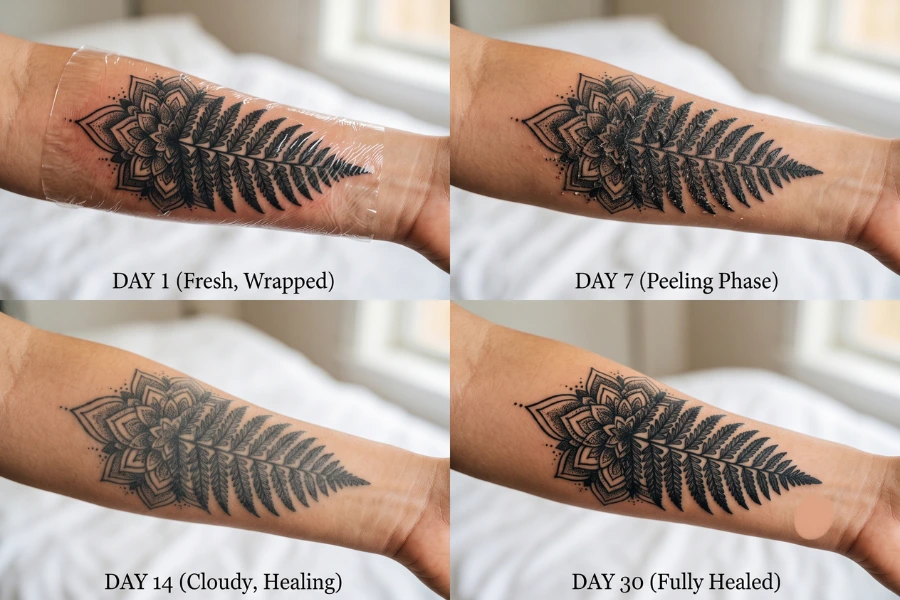
Plastic wrap or cling film — Traditional, cheap, effective for short-term protection during your ride home. Should be removed within 2-5 hours.
Second Skin adhesive film — Modern medical-grade transparent film. Can be left on for 24-72 hours. Blocks bacteria while allowing skin to breathe. Our studio uses this for most tattoos.
Your artist will tell you which one you have and when to remove it. Follow their specific instructions — don’t guess.
First Wrap Removal (Hours 2-24)
When it’s time to remove the wrap:
- Wash your hands thoroughly with antibacterial soap
- Gently peel the wrap in the shower under lukewarm water (helps release adhesive if it’s Second Skin)
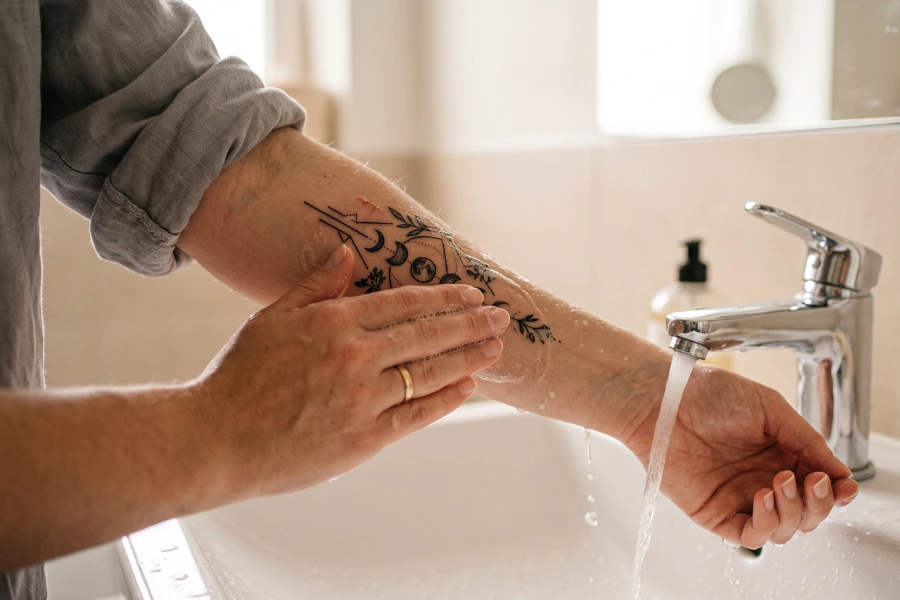
- Wash the tattoo with lukewarm water and fragrance-free antibacterial soap using only your clean hands — no cloth, no loofah
- Rinse thoroughly
- Pat dry with clean paper towel — not fabric, which harbors bacteria
- Air dry for 10-15 minutes before applying anything
You’ll see plasma, blood, and excess ink coming off during this wash. Normal. The tattoo may look cloudy or dulled — normal. Do not panic.
First Application of Aftercare Product
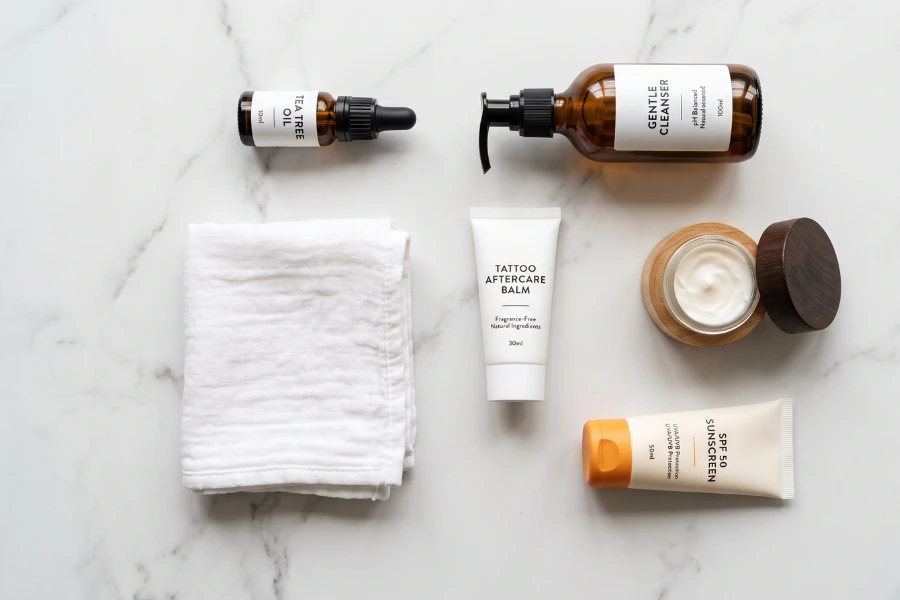
After the initial wash, apply a thin layer of tattoo-specific healing balm or fragrance-free ointment. Thin means barely visible — you should be able to see the tattoo through the layer, not a shiny thick coating.
Products we recommend from experience:
- Dedicated tattoo aftercare balm — Any fragrance-free option formulated for tattoo healing
- Aquaphor Healing Ointment — Reliable Western option, available at pharmacies
- Bepanthen Cream — European standard, excellent for sensitive skin
- Coconut oil — Only if truly organic virgin coconut oil, not cooking oil with additives
Reapply 2-3 times per day for the first 48 hours. Not more — over-moisturizing traps bacteria.
What to Avoid in First 48 Hours
- No swimming (pool, ocean, hot tub, bathtub soaking)
- No direct sun exposure
- No alcohol (thins blood, prolongs healing)
- No aggressive exercise (excess sweating on fresh tattoo)
- No touching except during cleaning
- No sleeping directly on the tattoo (use fresh pillowcase, keep pressure off)
- No tight clothing that rubs the area
If you’re staying at a Bali accommodation, request extra clean towels for the first 3 days. Hotel and villa laundry standards vary.
Days 3-14: Active Healing Phase
This is when your tattoo starts looking terrible before it looks amazing. Understanding what’s normal prevents panic.
Day 3-5: The Ugly Phase
The tattoo may look cloudy or hazy, cracking or crusting at the edges, somewhat itchy, and maybe raised in areas.
All normal. Your body is forming a light protective layer over the healing skin. Do not pick, scratch, or peel this layer prematurely — it will come off naturally over the next week.
Continue your aftercare routine:
- Wash 2x daily with fragrance-free soap
- Pat dry with paper towel
- Apply thin layer of balm 2-3x daily
- Wear loose, breathable cotton clothing
If the tattoo feels tight or dry, that’s fine — resist over-applying product. Bali’s humidity often means less product needed than what home country tattoo studios recommend.
Day 6-10: Peeling Phase
Your tattoo starts flaking like a mild sunburn. Small flakes of dead skin will come off, sometimes tinted with ink color. This is called “ink shedding” and it’s the surface layer of skin — not your actual tattoo, which sits deeper in the dermis.
Do:
- Let flakes fall off naturally in shower
- Continue moisturizing gently
- Wear loose clothing
Don’t:
- Pick or peel flakes off manually
- Scratch when itchy — pat lightly instead
- Use exfoliating products of any kind
The tattoo will look progressively cleaner as flakes fall away. By day 10, most of the peeling is done.
Day 11-14: Settling Phase
Peeling wraps up. The tattoo may still look slightly cloudy — this is dead skin cells still shedding at microscopic level. Colors and details start becoming crisp again.
Reduce moisturizing to once daily. Continue avoiding sun exposure and swimming.
At this point, most tattoos on non-friction areas (forearm, shoulder, upper back) look mostly healed on the surface. Tattoos in high-movement areas (elbows, knees, ribs) may take a few extra days.
Weeks 2-4: Surface Healing Complete
By week 3-4, surface healing is essentially done. But you’re not out of the woods yet.
What “Healed” Actually Means
Surface healing means the outer skin layer has regenerated over your tattoo. But deeper skin healing continues for another 2-4 months. During this period:
- The tattoo LOOKS healed
- The tattoo FEELS healed
- But underlying tissue is still remodeling
This affects your care approach:
- Sun protection becomes critical (SPF 30+ minimum, SPF 50+ recommended for Bali)
- Avoid abrasive skincare on the tattoo area
- Continue gentle moisturizing (unscented lotion 1x daily)
- Wait another 2 weeks before returning to swimming
- No harsh exfoliants, retinols, or acid-based skincare on the area for 6 weeks
Sun Exposure Rules
This is where most Bali tattoos die a slow death. Fresh tattoos exposed to Bali’s UV without protection fade dramatically over the first 6 months.
Rules:
- Weeks 1-3: Zero direct sun exposure. Cover completely.
- Weeks 4-6: Brief sun exposure only with SPF 50+ applied. Reapply every 2 hours.
- After week 6: SPF 30+ minimum for all sun exposure, forever. Reapply every 2 hours in Bali sun.
Buy a good sunscreen when you arrive in Bali. La Roche-Posay Anthelios, Supergoop, or Australian brands like Sun Bum work well. Avoid cheap sunscreens — they don’t protect adequately.
Yes, this means putting sunscreen on your tattoo forever if you’re outdoors. It’s the single most important factor for long-term tattoo vibrancy.
Bali-Specific Aftercare Challenges
Standard aftercare guides don’t cover these. This section is why we wrote this guide.
Beach and Ocean Exposure
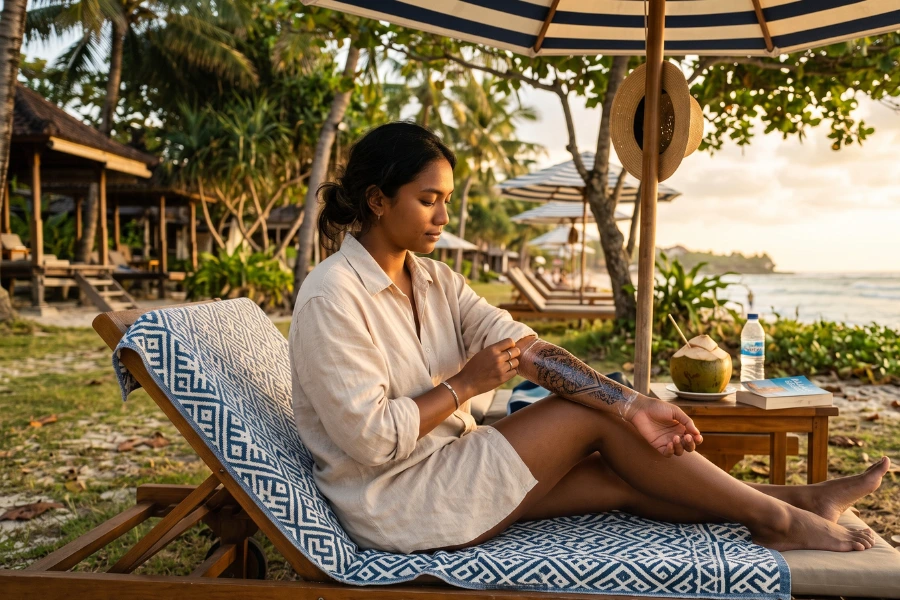
When can you swim? Not for 3-4 weeks minimum. Ideally 6 weeks for saltwater beaches.
Why so long? Saltwater carries bacteria that fresh tattoos are vulnerable to. Sand introduces particles into healing skin. Chlorine in pools irritates and dries out healing skin.
Practical implication: If your Bali holiday is 2 weeks, you get your tattoo AT THE START of the trip and skip the beach and pool time, OR you get your tattoo at the END and enjoy beach days first.
Getting a tattoo mid-trip and expecting to swim afterward equals healing complications. This is one of the most common mistakes we see.
Tropical Humidity Management
Bali’s humidity keeps your skin moist naturally, which is good for healing. But it also means:
- Sweat accumulates on tattoo — clean more frequently (3x daily during peak humidity)
- Bacteria grow faster in warm moist environments — stricter hygiene needed
- Clothing traps moisture against tattoo — wear loose breathable cotton, change if sweaty
Air-conditioned rooms help significantly during initial healing. If your accommodation has AC, use it — helps keep the tattoo dry when you’re not actively cleaning.
Mosquito and Insect Protection
Bali has mosquitoes. Fresh tattoos are attractive to insects (warm inflamed skin). Practical steps:
- Use natural insect repellent (citronella, eucalyptus based) around the tattoo area
- Avoid DEET-based products directly on the tattoo — they can irritate healing skin
- Cover the tattoo with loose clothing when possible
- Sleep under a mosquito net if your accommodation has one
Mosquito bites on a fresh tattoo increase infection risk and cause intense itching that’s hard to resist scratching.
Local Water Quality Considerations
Do NOT use tap water for cleaning your healing tattoo, even for the first wash. Bali tap water isn’t safe for consumption, and it’s not ideal for open skin either.
Use bottled water for the first week when cleaning. After the first week, filtered shower water is generally fine (bacteria in shower water is less concerning than direct tap water, but still).
Bring bottled water into the shower for the wash if your accommodation’s shower water quality is uncertain.
Diet and Alcohol Considerations
Bali holiday temptations are real. But during healing:
- Skip alcohol for at least the first week (thins blood, slows healing)
- Stay well hydrated (Bali heat plus healing equals dehydration risk)
- Eat protein-rich meals (helps skin regeneration)
- Avoid excessive sun-heavy activities (surfing, all-day beach clubs)
You can still enjoy your holiday. Just adjust the first 2 weeks to be tattoo-friendly.
Warning Signs: When to Seek Medical Care
Most healing goes smoothly. But knowing warning signs prevents serious problems.
Normal healing (don’t panic):
- Redness around tattoo for 2-4 days
- Some swelling early on
- Itchiness during days 5-10
- Peeling flakes days 7-14
- Skin feels tight or dry
- Mild warmth to touch first few days
Concerning signs (contact your studio or doctor):
- Redness that spreads outward and grows worse after day 4
- Pus discharge (yellow or green) or foul smell
- Fever, chills, or feeling unwell
- Severe swelling that increases rather than decreases
- Red streaks radiating from tattoo
- Warmth that persists beyond day 4 or increases
- Severe pain that increases rather than decreases
When in doubt, seek medical care. Bali has multiple international clinics that handle tourist medical concerns:
Bring photos of your tattoo from day 1 for comparison. Bring the studio’s contact information — a good studio helps troubleshoot even during healing.
At Utopia Ink Bali, we’re available via WhatsApp for aftercare questions during business hours — including after you’ve returned home from your holiday. This is what a professional studio should offer.
Long-Term Care: The Next 5+ Years
Once surface healing is complete, aftercare shifts from active healing mode to preservation mode.
Sun Protection Forever
Direct sun exposure is the #1 cause of tattoo fading. UV rays break down ink pigments over time. In Bali sun, this happens fast.
Non-negotiable practices:
- SPF 30+ minimum every day the tattoo is exposed to sun
- SPF 50+ recommended for beach days, water sports, extended outdoor time
- Reapply every 2 hours in Bali sun, every 3-4 hours in cooler climates
- Don’t rely on clothing alone (light fabric transmits UV)
Best sunscreens for tattoo protection:
- Mineral-based (zinc oxide) — least irritating
- Broad-spectrum UVA + UVB
- Water-resistant for outdoor activities
- Ideally fragrance-free
Moisturizing Routine
Keep tattoo skin healthy with regular moisturizing:
- Once daily minimum with unscented lotion
- After showering while skin is still slightly damp
- More frequently in dry environments or after sun exposure
Products that work well:
- Cetaphil Moisturizing Cream
- CeraVe Moisturizing Cream
- Aveeno Daily Moisturizing Lotion
- Natural options: shea butter, jojoba oil (test small patch first)
Skincare Considerations
If your tattoo is in an area where you use skincare products, adjust routine:
- Avoid retinols and Vitamin A derivatives directly on tattoo (accelerates fading)
- Avoid AHA/BHA exfoliants on the tattoo area
- Avoid Vitamin C serums on freshly healed tattoos (first 6 months)
- Regular anti-aging skincare is fine after 1 year
Touch-Ups: When and Why
Most tattoos need touch-ups eventually:
- 6-12 months post-original: minor blowout corrections, sharpen fine lines
- 3-5 years: refresh fading color, restore vibrancy
- 8-10 years: significant refresh (especially for older fine line pieces)
Touch-up policies vary between studios. At Utopia Ink Bali, we provide free touch-ups within 6 months for tattoos placed in areas known to heal poorly (ear, behind the ear, hand, neck, finger, foot) — these placements often need attention regardless of session quality. For tattoos on more stable areas, touch-ups are quoted based on work required.
If you’re returning to Bali years later, we welcome touch-up appointments for original clients. Bring your original tattoo photos for reference.
Aftercare check-ins during your Bali stay: Because we’re located on Jl. Kayu Jati in Seminyak (next to Motel Mexicola, walking distance from most Seminyak hotels including Alila Seminyak, Hotel Indigo, Desa Potato Head Bali, W Bali, and Grand Mercure), it’s easy to drop by during your holiday if you have healing concerns. This proximity makes a real difference when questions come up mid-trip — much better than trying to solve issues via message alone.
Aftercare Timeline: Quick Reference Card
For easy reference, here’s the compressed timeline:
Hours 0-24:
- Keep original wrap on until artist’s specified time
- First wash: lukewarm water + fragrance-free soap
- Apply thin layer of aftercare balm
Days 1-7:
- Wash 2x daily, pat dry with paper towel
- Apply balm 2-3x daily (thin layers only)
- No swimming, no direct sun, no alcohol
- Wear loose cotton clothing
Days 8-14:
- Continue washing but reduce moisturizing to 1x daily
- Peeling normal — do not pick
- Still no swimming, still no direct sun
Days 15-30:
- Surface healing mostly complete
- Introduce sunscreen (SPF 50+) if any sun exposure
- Can resume light exercise but avoid heavy sweating on tattoo
- No swimming yet in ocean; brief pool exposure OK after day 21
Weeks 4-8:
- Normal skincare routine can resume around tattoo area
- Continue daily moisturizing
- SPF 30+ minimum for any sun exposure
Months 2-6:
- Deep skin healing continues (invisible)
- Maintain sun protection religiously
- No harsh skincare products on tattoo area
Years 1+:
- Sun protection forever
- Daily moisturizing keeps skin healthy
- Touch-up scheduling as needed
Print this and stick it on your bathroom mirror during healing.
Frequently Asked Questions
How long does a tattoo take to heal in Bali’s tropical climate?
Surface healing takes 2-4 weeks in Bali (similar to other climates). Full skin regeneration takes 2-6 months. Bali’s humidity can slow initial healing slightly due to bacterial exposure risk, but proper aftercare compensates completely.
Can I swim in Bali after getting a tattoo?
No swimming for at least 3-4 weeks. Salt water, chlorine, and beach sand introduce infection risk during the healing window. For ocean swimming, wait 4-6 weeks ideally.
What moisturizer is best for tattoo healing in Bali’s climate?
Fragrance-free, non-petroleum products work best. Look for tattoo-specific aftercare balms formulated for tropical climate use. Well-known international options include Aquaphor, Bepanthen, and Cetaphil. Avoid heavy petroleum-based ointments that trap moisture and bacteria.
Should I use sunscreen on my healing tattoo?
Not during the first 2-3 weeks (skin is too fragile). After surface healing is complete, apply broad-spectrum SPF 30+ before any sun exposure. In Bali, reapply every 2 hours. UV exposure permanently fades tattoo ink.
Can I use insect repellent near my healing tattoo?
Natural repellents (citronella, eucalyptus) around the tattoo area are safer than DEET-based products directly on the healing skin. Cover the tattoo with loose clothing when possible in mosquito-heavy environments.
How do I know if my tattoo is infected?
Warning signs: redness spreading outward after day 4, pus discharge, fever, severe swelling, red streaks radiating from tattoo, foul smell. If any of these appear, seek medical care immediately. Normal healing includes some redness and swelling for 2-4 days that decreases over time.
When should I get a tattoo touch-up?
Minor touch-ups: 6-12 months post-original if blowout or minor blurring occurred. Refresh touch-ups: every 3-5 years to maintain vibrancy. Signs you need a touch-up: visible fading, softened lines, uneven color. Most studios include one free touch-up in original cost.
Can I fly with a fresh tattoo?
Yes, flying shortly after your tattoo is generally fine — many Bali visitors get their tattoo on the last day or two of their holiday before flying home. Practical tips: apply a thin layer of aftercare product before your flight, wear loose comfortable clothing over the tattoo area, keep the tattoo covered (with wrap or Second Skin your artist provided), avoid contact with airplane surfaces and blankets when possible, and stay hydrated during the flight. Your tattoo will continue healing normally regardless of the flight.
Is Bali tap water safe for cleaning my healing tattoo?
No — Bali tap water isn’t safe for consumption or for cleaning healing skin. Use bottled water for the first week during cleaning. Filtered shower water is acceptable after week 1 for rinsing.
What if I get sunburned on my healing tattoo?
Sunburn on healing tattoo causes fading and can damage the design. If you burn accidentally, apply cool compresses, aloe vera (fragrance-free), and keep the area moisturized. Avoid further sun exposure until healed. Contact your studio if the tattoo area is significantly affected.
Can I apply lotion right after my tattoo session?
Only the specific aftercare product your artist recommends. General body lotion often contains fragrances, alcohol, or chemicals that irritate fresh tattoos. Use only fragrance-free tattoo-specific products for the first 2 weeks.
How long until I can exercise after getting a tattoo?
Light exercise (walking, gentle yoga): after 48 hours. Moderate exercise (jogging, weight training): after 5-7 days. Heavy exercise (intense sports, contact sports): after 2 weeks. Swimming: 3-4 weeks minimum. Excessive sweating on fresh tattoo increases infection risk.
The Bottom Line
Tattoo aftercare in Bali isn’t complicated — it’s just specific. Adjust standard aftercare for tropical conditions, respect the healing timeline, and your tattoo will heal beautifully.
The mistakes we see repeatedly:
- Going to the beach too soon
- Using unclean water for cleaning
- Skipping sunscreen after surface healing
- Over-moisturizing with thick greasy layers
- Under-moisturizing (letting skin crack from dryness)
- Picking at peeling skin
The successes we see:
- Following the timeline patiently
- Using quality tattoo-specific aftercare products (Aquaphor, Bepanthen, or similar fragrance-free options)
- Respecting sun protection forever
- Reaching out for help when unsure
- Documenting healing with photos for reference
Your tattoo is a permanent piece of art. The 4 weeks of careful healing are the investment that keeps it looking good for the next 50 years.
If you have questions during healing, contact our team via WhatsApp — we’re happy to help troubleshoot. If you’re planning a tattoo and haven’t booked yet, read our tattoo preparation guide for pre-session steps.
Whatever tattoo you have, wherever you had it done, we hope this guide helps it heal into something you’ll love forever.
